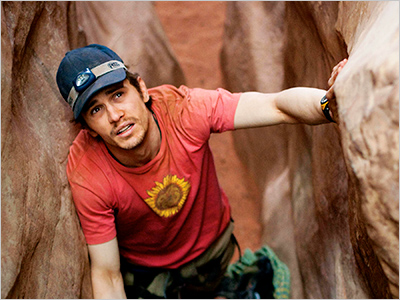
 127 Hours is truly something you don’t want to miss. Many people I’ve talked to say they don’t think they could sit through a movie like this. But they are only focusing on the fact mountaineer Aron Ralston had to cut off his arm to escape certain death from a fall in a canyon.
Director Danny Boyle and actor James Franco bring so much more to it than that. Boyle’s vision of this man’s courageous story is all at once alerting, revolting, hilarious, panoramic, compelling — and a lot in between. And with an actor like Franco, it’s all played out with true brilliance and stamina. The film will most certainly be an major Oscar contender, and lucky for me, I got to speak with both filmmaker, actor, writer — and the man himself, Aron Ralston. What a fascinating afternoon…
James Franco and Danny Boyle
Boyle on how he wanted to tell the tale:
“I said to Aron, I want to tell the story through an actor, I don’t want to tell it through you. Which was weird because he’d just written the book and had control of it. He heard horrendous stories about Hollywood, how they chewed up real-life stories and put happy endings on them. The guy gets out, his arm’s OK, the surgeon works miracles. Everything’s fine. I told him not to worry about any of that, we’ll tell it through an actor.”
“I’m an actor’s director, I like actors, I trust actors to tell stories. And all the stuff you hear about them is fine, and the gossip is fine, but what they REALLY do is something very, very basic and very old, much older than documentaries, which is they kind of live out stories for us. We put ourselves in their place, we’re happy, we’re sad, we’re angry with them. We fall in love and that’s how to tell Aron’s story. It’s so cathartic. If he entrusted to an actor and me and we pull it off, he would feel like he never felt before. Because he’d take people to a place that is unbearable. And in any other form, they will not be able to tolerate. People aren’t going to watch it unless you can get a great actor who will live it out for you, take you on that journey.”
“And you know how it is when it’s a bad actor, you just get annoyed. Because they are abusing that trust you want to put in actors. Makes me furious. I get angry at the ones who cast them and they way it’s come about because they are not really actors, but celebrities or whatever it is. Acting is a weird profession because it’s so deeply embedded in us to let them play out these massive psycho-dramas for us. But I told Aron all this and I think it was his wife, Jessica, who convinced him to entrust us with the story. And we said we’d give it back to him after it was done, which we do in a symbolic moment at the end of the film.”
Franco on playing Aron:
“I loved examining a person by stripping everything away. Having everything he’s used to and taken for granted in life, taken away so he is just faced with the essentials of what life is made of. And also have to just stare death in the face. Powerful material and a powerful approach to that material. As for performing all that, there were many different levels. I got to see the actual videos Aron made while in the canyon. Sure, he told me every second of what he felt along the way. But seeing those videos made it more pure, because it wasn’t Aron telling us the experience, it was Aron in the middle of that experience and not knowing he’s going to get out. He believed he was going to die, making those video up to an hour before he escaped.”
“You could tell there was a lot more going on underneath. But kept up this dignified demeanor for his parents and family, so they wouldn’t see him crumbling in front of the camera. So that’s one the key things I used to do the role. You also have to use every experience you have as a person and amplify that. Of course, I’ve never experienced something like this, but I remember after I got my pilot’s license a few years ago, going up in those little planes, I’d ask ‘OK, if this goes down, that’s it. Are you ready for that, James?’ Have this conversation with myself, as you do. I just take that kind of thing and amplify it.”
Boyle on shooting the movie:
“In a purely narrative sense, you have to establish that rock will not move, enter into this bargain for the rest of the story. We had the cameras, we had the set, which was sealed. It wasn’t movable, wasn’t flexible. It was the real deal, well, as much as it could be in a warehouse in Salt Lake City. We didn’t know how to shoot it. We had a bit of confidence from Slumdog, bit of a role. But we decided to go for it, refocusing between a third person and first person. It’s sort of point of view, and sort of observed, constantly going between the two like that. It dictated the rest of the film.”
Franco on being squeamish:
“I can’t have my blood taken, just don’t like it. I’ve passed out at blood drives. So yeah, wonder how I got through that scene. Funny thing, Aron told me he was squeamish around blood, too, but there is something you can work up in yourself and can’t past if you need to. Of course Aron’s was real and mine was a fake arm, but they did such a good job making this prosthetic arm real. It’s very intense and hard to watch, but there’s a lot Danny could have put in that he didn’t. They built a real arm, with veins and tendons. In hindsight, I just did and didn’t pass out, I guess. But a friend of mine from NYU shot a behind the scenes documentary for the film and I just watched a bit of that scene being done. I guess after the first take, I told Danny he got an authentic performance because I was feeling a little light headed. And we have it on video.”
Screenwriter Simon Beaufoy
On meeting Aron Ralston:
“I had some specific requests, personal. I leveled with him and said we weren’t going to just make a survival movie because it’s not going to touch people in the same way. We could do something more than just tell the facts. Make this a very powerful story about other things, get to the emotional truth of the situation. But to do that, I needed some pretty tough stuff from Aron that he didn’t put in his book. And was he prepared to give us that stuff? And he was!”
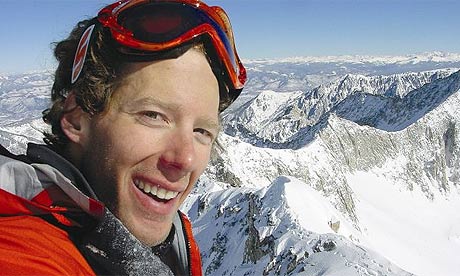
Aron Ralston
On how he could cut off his arm:
“Sure, everyone going into the film is thinking this is the guy who cut his arm off but hopefully when they leave, they’ll be glad he’s the guy who cut his arm off, so he could get out of there. That smile on James’ face when he’s doing that, that’s real. I WAS smiling, because I saw it as a triumph, an exuberant feeling of euphoria, which it was for me. The most intense pain I’ll ever experience, for sure, but I was grinning from ear to ear. Cause I was gonna get out there and see all the people I love.”
“It was the riddle of how do you saw through your bones? But you don’t saw through, you break. And then the boulder becomes the solution, not the problem, because I can use the vice-like grip to break the bones. It dawned on me, out of a moment of rage, trying to rip my arm free. It took one hour and four minutes from the time to break my bones and then cut myself free. And I was euphoric the whole time.”
On watching it with his mother:
“It’s been emotional every time I’ve seen it. My mom sitting with me, holding my hand, by the end as there’s the building salvation… at this point, my mom is clutching my hand so hard, I think I’m going to lose my other hand. We are both involuntarily rocking back and forth, and she kept saying, ‘Thank you, God, thank you, God.’ It bonded us even more. Danny gave my family and me this story, truly a gift.”
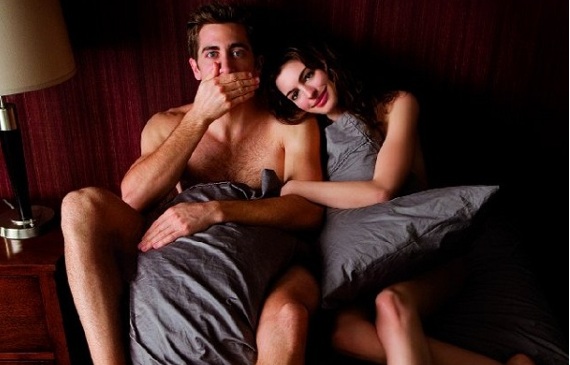 Step 1: Get in bed. Remember the game of reading fortune cookie proclamations out loud and ending them with the phrase “in bed”? Like, “You will have great wealth and prosperity – in bed” or “The sun will always shine on you – in bed.” That’s sort of how I feel Love and Other Drugs ended many scenes – in bed.